Global Classroom Connect Logo

Global Classroom Connect Lesson Plan

Global Classroom Connect » Lessons » Ada’s Violin / SDGs and The Global Competency Indicators

Ada’s Violin / SDGs and The Global Competency Indicators

Author: Greg Gaiera
Grade Level(s): 3-5 | 6-8

Lesson Objective

  • Students will review the SDG’s
  • Students will review the Global Competency Indicators
  • Students will relate Ada’s Violin to one SDG
  • Students will relate  Ada’s Violin to three Global Competency  indicators

Overview


Students will review the SDGs and Global Competency Indicators. Students will listen to a read aloud of Ada’s Violin. Afterwards there will be a  short, whole class discussion about which SDGs Ada’s Violin addresses. Students will vote to pick the SDG that most relates to the story. In the next lesson, students will “Translate” six global Competencies into kid language. Finally, the students will identify  three indicators that the characters use in the book to help that  SDG. This lesson most strongly connects to Sustainable Development Goal 12: Responsible Consumption and Production, SDG 11: Sustainable Cities and Communitiesv and, SDG 15: Life on Land

Preparation

• Students should be familiar with the SDGs. Fourth graders like to define the SDGs as “Ways to make the world better and how to treat people equally.”]

•  Print SDG Icons for your classroom.

•  For younger grades, it’s a good idea the treacher to think about SDG’s in “kid language”. For example, #12 Responsible Consumption and Production could be taught as “making and using things in a way that doesn’t harm the planet.

• Familiarize yourself with California Global Education Project’s Global Competency Indicators. You can find information about them here.

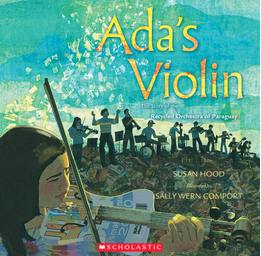
•  Read or watch Ada’s Violin

• Students should be familiar with the indicators. A kid friendly definition is “Ways that PEOPLE can be better.

Lesson 1 (30 min):Read Ada’s Violin and relate it to an SDG

  1. Display the SDG icons in a visible place in your classroom.  Remind students about the SDGs. (Ways to make the world better.). Say : “You are going to listen to a book where people make musical instruments out of some pretty surprising things. We are going to decide which SDG the people in this book help the most.
  2. Scaffolding: Consider pointing out  a few of the SDG’s that Ada’s Violin addresses: Make the world a better place, Life on Land, Responsible Consumption and Production, Sustainable Cities and Communities
  3. Say, “After we finish the read aloud, we are going to vote to pick one SDG that we think this book is mostly about. (Picking one is not absolutely necessary)
  4. Guide students to sit in read aloud spots. All students should be able to see the pictures. If you don’t have the book, you can use this recording: Ada’s Violin read aloud.
  5. Break students into small groups and have them discuss their opinions about what SDG  Ada’s Violin helps the most.
  6. Class vote on most appropriate SDG.

Lesson 2 (30 min):  Translating the Global Competency Indicators into Kid Language

Lesson Objective:  The “Global Competency Indicators” while very meaningful, are sometimes hard for younger students to comprehend. This lesson will help students put the indicators in their own words.

  1. Group students in pairs or in small groups.
  2. Pass out Translating the Indicators  document.
  3. Say: Global Competency indicators are ways of thinking and being that people can use to make the world a better place. Characters in the book, Ada’s Violin used these indicators to help achieve an SDG. It’s important for you to understand what each one  means, so each group is going to put the indicators in your own words. You can use examples (but not from the book yet). You can also ask me or look up words on Google.
  4. Have students discuss the meanings of the indicators and write down a general definition with a general example. (not examples from the book)
  5. Words that may need to be defined: persist. reflect, collaboratively, capitalize
  6. Have students discuss the meanings of each indicator using their definitions and examples from the book.

Lesson 3 (40 minutes):  Identifying 3 indicators that characters used in Ada’s Violin

Lesson Objective: Students will listen to Ada’s Violin again and pick three Global Competency Indicators that characters use in the book.  

  1. Say: We will be rereading Ada’s Violin today. Today you will be listening for what indicators characters use in the book.  Afterwards, you will be picking three of the indicators that we talked about in the last lesson.
  2. Read Ada’s Violin to the students.
  3. Pass out Relating the Indicators to Ada’s Violin 
  4. Have students work in pairs to pick 3 of the indicators and explain how characters in the book used them.
  5. For example: Ada kept an open mind by being okay with playing a violin made out of trash and Niocolas Gomes applied creative thinking to build the instruments out of trash.
  6. Have a brief class discussion about the characters using the indicators

Sustainable Development Goals

This lesson most strongly connects to Sustainable Development Goal 12: Responsible Consumption and Production, as students explore how discarded materials can be repurposed into meaningful resources, as seen in Ada’s Violin. It also supports SDG 11: Sustainable Cities and Communities by highlighting how communities can creatively improve their environments, and SDG 15: Life on Land through awareness of waste and its impact on ecosystems. More broadly, the lesson encourages students to think about how individual and collective actions can make the world more sustainable.

Standards

English Language Arts (ELA – Common Core CA)

  • RL.3–5.1 – Ask/answer questions using evidence from the text
  • RL.3–5.2 – Determine theme or central message
  • RL.3–5.3 – Describe characters and their actions
  • SL.3–5.1 – Engage in collaborative discussions
  • SL.3–5.4 – Report ideas clearly
  • W.3–5.2 – Write informative/explanatory pieces

History–Social Science

  • 3–5 Civic/Community Understanding – Understand how people work together to improve communities
  • 4–5 Global Awareness – Recognize connections between people, environments, and resources
  • 5.4 / 5.7 (Civic ideals) – Understand roles, responsibility, and contributions to society

California Environmental Principles & Concepts (EP&Cs)

  • Principle I – People depend on natural systems
  • Principle II – People influence natural systems
  • Principle III – Natural systems change over time
  • Principle IV – Decisions affect resources and sustainab